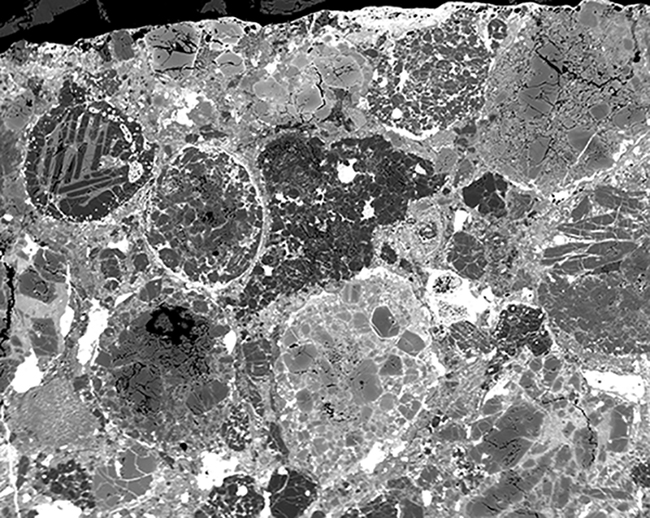
Anthony Love: The purpose of my work is to describe and analyze meteorites, which represent rare samples that originated on asteroids and planets that help tell the story of the early history of our solar system. To classify a meteorite requires detailed petrographic and chemical characterization of the minerals within a given sample. This characterization provides information about geologic processes that occurred on meteorite parent bodies, the shock processes that liberated them from these bodies and finally the weathering characteristics they have experienced while in residence here on Earth. The JEOL ITS-300 scanning electron microscope with energy dispersive spectroscopy is an essential tool used to analyze mineral compositions from these samples. Reports for each specimen summarize this data and are published in a database managed by an international consortium of planetary scientists, the Meteoritical Society Meteorite Bulletin.
These samples are found in the Saharan desert countries of Mali, Mauritania, Morocco, Western Sahara, Algeria and Libya and the Taklamakan, Gobi and Xinjiang deserts of China and Inner Mongolia. On rare occasions, we have the privilege of working on samples that have recently fallen to Earth.
The most important aspect of this study is that the University retains piece of the sample to promote and enable further study by other scientists. International and domestic researchers request aliquots of samples to apply a greater range of petrographic and geochemical analytical techniques that are unavailable here at App State. Samples from our collection have been studied by multiple planetary scientists (from NASA, the Lunar and Planetary Institute, University of California San Diego, Texas Christian University, Boston College, University of Washing, University of Arizona, Lund University-Sweden, University of Frankfort, London Museum of Natural History and Munich Museum of Mineralogy) and have provided new and important insights about the geologic evolution of asteroids, Mars and Earth’s moon. Our collection also serves as a teaching resource for Geological and Environmental Sciences in Introduction to Meteoritics and Cosmochemistry as well as our Petrology course and less frequently as a teaching aid within Physics and Astronomy. Finally, time on the SEM is funded by the collaborators and institutions to help provide support for the College of Arts and Sciences Dewel Microscopy Facility.